Payment Orchestration Layer: A Beginner's Guide
What Is a Payment Orchestration Layer? A Beginner's Guide
If you've read about payment failures, gateway downtime, or businesses juggling multiple payment providers, you've probably come across the term payment orchestration layer. It sounds technical. However, the idea behind it is fairly simple once you break it down.
This guide walks through what it actually is, how it works, and when a business genuinely needs one.
The Problem It Solves
Most growing businesses don't start with just one payment provider. They add a second gateway for redundancy. They add a third for better rates in a specific region. Maybe a fourth follows, because one customer segment prefers it. Each one comes with its own integration, its own dashboard, and its own quirks.
Without something tying these together, the business ends up managing five separate payment problems instead of one payment system. A failure in one provider becomes a checkout failure for the whole business. There's simply no automatic way to reroute the transaction elsewhere.
What a Payment Orchestration Layer Actually Is
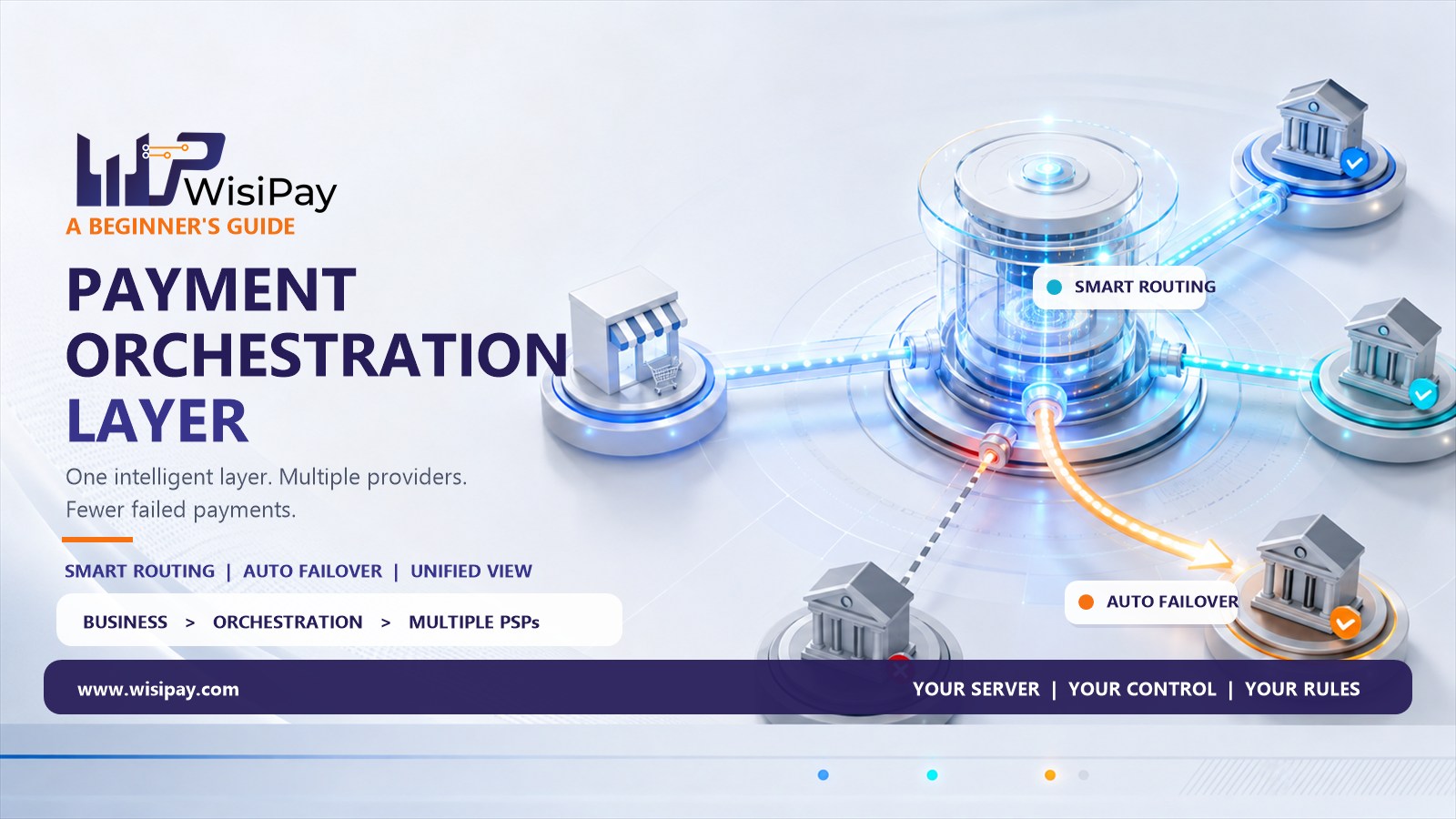
A payment orchestration layer is middleware that sits between your business and your payment service providers. Your checkout doesn't talk to each provider separately anymore. Instead, it talks to the orchestration layer, and that layer decides how every transaction should move through your stack.
Think of it as a smart control tower. It doesn't process payments itself. Instead, it manages connections, makes routing decisions, and keeps everything reporting back into one place.
The Core Pieces That Make It Work
A payment orchestration layer is usually built from a few key components working together.
Provider connectivity removes the need for separate, one-off integrations with every payment processor. You connect once, and the orchestration layer handles the rest.
Routing and failover is the real engine behind the system. It reads details like the transaction amount, currency, customer location, and payment method. Then it picks the best available provider for that specific transaction. If the chosen provider fails or declines, the system reroutes to another one automatically, often before the customer even notices.
Checkout infrastructure adapts to the customer. It shows the right payment methods and currency based on where they are and what they prefer.
Unified reporting pulls data from every provider into a single dashboard. Instead of checking four different portals to understand what happened to a payment, your team checks one.
How a Transaction Actually Flows Through It
Here's what happens in practice, in a few simple steps.
A customer initiates a payment. The orchestration layer evaluates the transaction in real time. It looks at factors like card type, issuing bank, and past performance data for each available provider. Based on that evaluation, it routes the payment to what it calculates as the best-fit provider.
If that provider processes the payment successfully, the transaction completes, and the result gets logged centrally. However, if the provider fails, times out, or declines the transaction, the story doesn't end there. The orchestration layer automatically retries through a different provider, instead of simply returning a failure to the customer.
Why This Matters More Than It Sounds
The benefits aren't just technical convenience. They show up directly in business outcomes.
Authorization rates tend to improve. That's because the system can route each transaction through the provider most likely to succeed for that specific card, currency, or region. Even a small lift in successful transactions adds up meaningfully at scale.
Subscription businesses see real retention benefits too. When a customer's card details change, features like automatic card updating prevent the failed renewal that would otherwise cause churn.
There's also a quieter operational benefit. Manual reconciliation drops. PCI compliance gets simpler, since there are fewer raw integrations to manage. Engineering teams also spend less time maintaining connections to providers one by one.
Who Actually Needs One
Not every business needs an orchestration layer on day one. A small business processing a modest, steady volume through a single reliable gateway often doesn't need this complexity yet.
However, certain signs suggest it's time to consider one. Maybe your business already uses more than one payment provider. Maybe an outage once took down your entire checkout. Or maybe you're expanding into new regions with different preferred payment methods. In any of these cases, an orchestration layer starts solving real, current problems rather than hypothetical ones.
Common Questions About Payment Orchestration
Is a payment orchestration layer the same as a payment gateway? No. A gateway processes a single transaction through one provider. An orchestration layer sits above multiple gateways and decides which one should handle each transaction.
Does adding this layer slow down checkout? It shouldn't. Routing decisions happen in milliseconds, and the added reliability from failover usually outweighs any negligible delay.
Can a small business use one, or is this only for large enterprises? Smaller businesses can use one too, especially once they add a second payment provider or start expanding into new markets. It's less about company size and more about how many providers and regions you're managing.
Does orchestration replace the need for a good payment provider? No. It works alongside your providers rather than replacing them. The orchestration layer decides which provider to use for each transaction; it doesn't process the payment itself.
How This Connects to What We Build
This is exactly the layer Wisi Pay is built around. Rather than treating each payment provider as a separate integration to maintain, our platform routes transactions intelligently and handles failover automatically. Every transaction stays visible through a single, unified view. Explore how Wisi Pay's orchestration platform works in practice.
Getting Started With Orchestration
If you're considering this shift, start by mapping out your current payment stack. List every provider you use. Note where failures have happened before. Identify where manual reconciliation eats up the most time. That map becomes the starting point for deciding what an orchestration layer needs to handle for your specific business.
From there, the goal isn't to add complexity. It's to replace scattered, fragile connections with one dependable layer that just works, quietly, in the background. Talk to our team if you'd like help figuring out whether your business is ready for one.
Does your business currently rely on a single payment provider, or have you already started adding more?
Sources:
What is a payment orchestration layer & how does it work? — Solidgate
What Is Payment Orchestration? Complete Guide — Solidgate
Ak singh
admin