Immutable Audit Trails for Financial Institutions | WisiPay
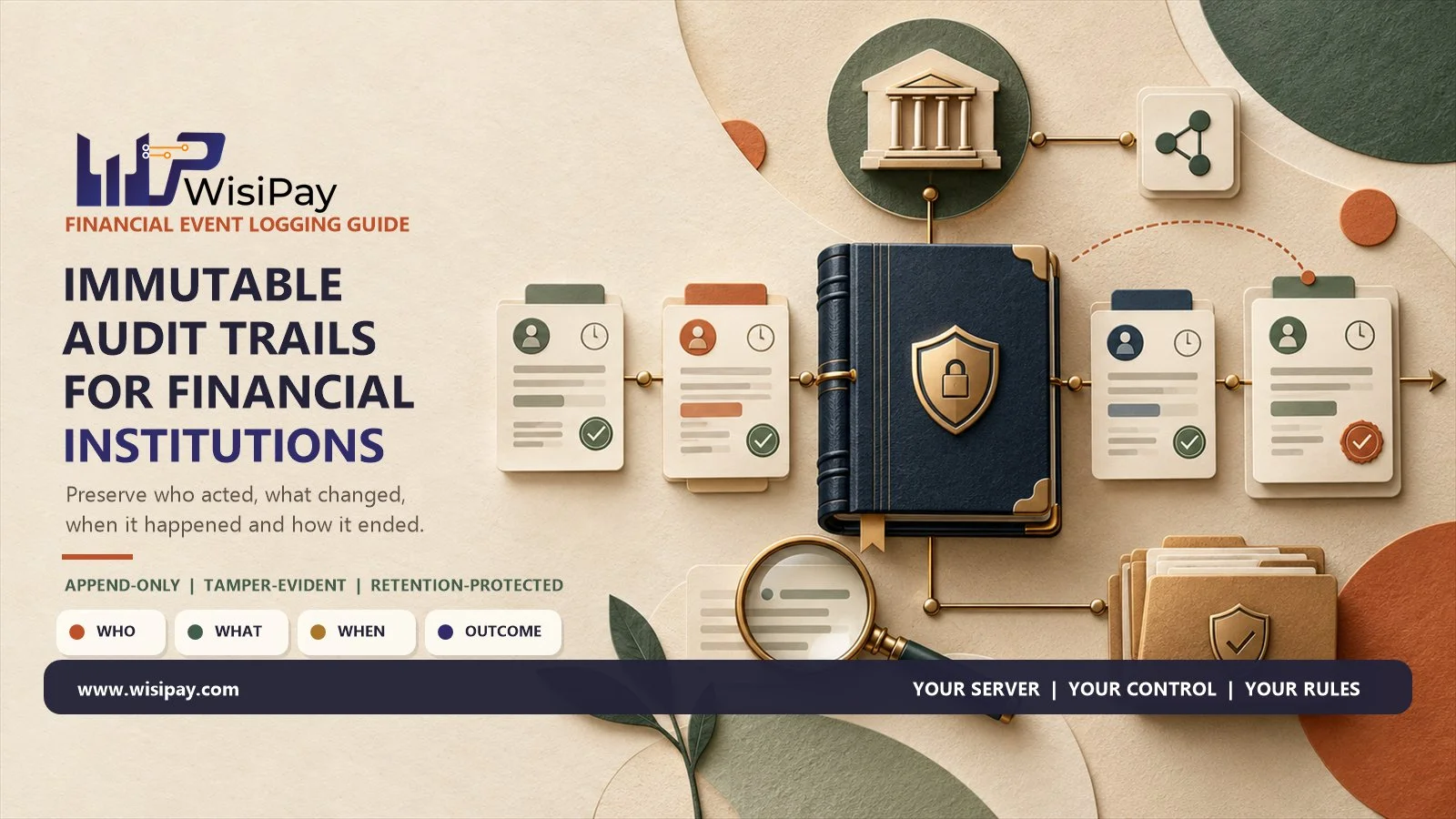
Immutable audit trails for financial institutions should preserve a traceable history of important actions and decisions: who acted, what changed, when it happened, which record was affected and how the action ended. The trail also needs controls that protect earlier events from unauthorised alteration.
A record that says “customer updated” leaves important questions unanswered. Did someone change a phone number, replace a beneficiary account or correct an address? Was the action performed by an employee, an integration or the customer? Did it require approval?
Useful financial audit logging starts with those questions. This guide proposes an event structure and coverage plan that banks, NBFCs and fintech teams can adapt to their workflows.
What Makes an Audit Trail Immutable?
An immutable audit trail is designed to preserve existing records against modification or deletion within defined controls. Its protection depends on the application, storage configuration, administrative permissions and retention design.
Related terms describe different properties:
- Append-only: New events are added without overwriting earlier entries through the normal write process.
- Tamper-evident: Integrity checks provide a way to detect changes to protected records.
- Retention-protected: Storage controls restrict modification or deletion for a configured period.
Document which protections apply and which privileged roles can affect them. A read-only dashboard alone does not establish that the underlying records are protected.
Immutability also cannot prove that an event was accurate when first recorded. Correct event generation and complete collection remain essential.
Start with a Consistent Audit Event Structure
OWASP recommends that application logs provide enough context to establish when, where, who and what for an event. Its guidance also addresses sensitive-data exclusions and protection of log records. Read the OWASP Logging Cheat Sheet.
The following is a suggested event structure for financial workflows. Adapt it to the evidence your reviewers actually need.
| Field | What it establishes | Illustrative value |
|---|---|---|
| Event ID | The identity of this individual event | EVT-10482 |
| Event type | The action or decision being recorded | beneficiary.change.requested |
| Actor reference and type | Who or what initiated the action | USR-217; employee |
| Target reference | The affected customer, account, case or transaction | BEN-603 |
| Event time and recorded time | When the action occurred and when the logging system received it | UTC timestamps with documented precision |
| Source system | Where the event originated | Operations dashboard; production |
| Correlation reference | The wider request or workflow containing the event | REQ-8821 |
| Outcome and reason | Whether the action succeeded, failed or needs review | Pending approval; beneficiary change |
| Version or change reference | Which version was reviewed or modified | Version 4 replaced version 3 |
Use stable references rather than relying only on display names. Names can change, and different users or customers can share the same name.
1. Record Customer and Beneficiary Changes
For customer onboarding and maintenance, define events around meaningful changes rather than recording only that a screen was saved.
Recommended coverage includes verification requests, review decisions, document-reference changes, contact updates and beneficiary additions or edits.
For each change, preserve the affected field names, actor, reason and relevant version references. Where earlier and revised values are necessary, protect them according to their sensitivity. Full identity documents and unrestricted account details do not need to be copied into every audit event.
Include unsuccessful attempts where they help explain a risk or operational issue. Repeated rejected beneficiary edits may deserve investigation even if no change was completed.
2. Link Approvals to the Version Reviewed
A financial transaction audit trail should distinguish preparation, review and execution.
For an approval decision, record the reviewer, decision time, transaction version, applicable approval-policy reference and any recorded reason. Keep rejection, return-for-correction and approval as separate outcomes.
Consider a payment approved at ₹40,000 and later changed to ₹60,000. The evidence should show both versions and establish whether the revised instruction received the required review.
This makes it possible to answer a precise question: “Which details did this person approve?” A generic approval timestamp cannot provide the same context.
3. Preserve Payment Attempts and Final Outcomes
Use separate references for the intended payment and each attempt to process it.
In a proposed payment event model, capture submission, acknowledgement, status updates, retries, reversals and reconciliation decisions. Link external references to the internal transaction without replacing the original history.
A timeout should remain distinguishable from a confirmed failure. Likewise, a successful submission should not be recorded as completed settlement unless that is what the provider’s response establishes.
Record how a manual resolution was reached, including the supporting reference and responsible reviewer. Otherwise, a transaction may appear closed without explaining why.
4. Identify API and Automated Actions
Automated actions need an attributable identity just as human actions do.
For a scheduled job, API call or webhook, a useful event can identify the calling service, operation, target reference, validation outcome and request correlation ID.
Where a service acts on behalf of a user, preserve both identities when available and appropriate. This helps distinguish “the employee requested the action” from “the integration executed it.”
Keep technical debugging payloads separate from the business audit record. Reviewers usually need the action, context and outcome rather than an unrestricted copy of every request body.
5. Capture Investigation and Case Decisions
For fraud, AML and operational cases, record meaningful transitions: case creation, assignment, evidence-reference additions, escalation, reviewer decisions and closure.
A closed alert should have a traceable explanation. Suggested fields include the decision category, reviewer identity, rationale and references to supporting evidence.
If the case is reopened, add another event linking back to the previous closure. Preserve the earlier decision so later reviewers can understand how the assessment changed.
6. Include Changes to Access and Logging Controls
The trail should also explain changes to the systems protecting financial activity.
Recommended administrative events include permission changes, privileged access, integration configuration changes, audit exports and changes to logging or retention settings.
For each, capture the responsible identity, scope, outcome and change reference. Give particular attention to actions that could reduce future visibility, such as disabling an event source.
NIST’s Guide to Computer Security Log Management treats log management as an organisational practice involving infrastructure and ongoing processes. Event generation needs to be supported by collection, review and maintenance.
Example: Reconstructing a Beneficiary Change
The following hypothetical sequence shows how separate events can form one useful history:
- An employee requests a beneficiary change, creating a new record version.
- The workflow records that payments using the changed destination need review.
- A reviewer accepts or rejects the proposed change.
- A payment instruction references the approved beneficiary version.
- The payment service records its submission attempt and provider reference.
- A later status event and reconciliation decision establish the outcome.
All six events retain their own identities while sharing the references needed to follow the sequence. An investigator can then compare the requested, approved and executed details.
Check Completeness as Well as Integrity
Protected records are useful only if the relevant events reach the logging system.
As an implementation check, disconnect an event source in a controlled test and observe what happens. Establish how the team detects the gap, tracks delayed events and confirms recovery.
Also test duplicate deliveries and late-arriving events. The audit history should retain the distinction between the original event time and collection time without implying an order that the evidence cannot establish.
Assign an owner to each source and document known coverage limits. This gives reviewers a way to judge whether a missing event reflects an absent action or incomplete collection.
How WisiPay Supports Financial Audit Workflows
WisiPay Audit Logs describes searchable trails for platform actions, API calls and decisions, with actor capture, tamper-evident records, configurable retention and exports.
During implementation, map your required event categories to the actual coverage of each connected module. Confirm field availability, privileged access, integrity controls and how external references are retained.
Contact WisiPay to discuss an audit event model for your onboarding, payment or investigation workflows.
Frequently Asked Questions
What should immutable audit trails for financial institutions record?
They should capture the identities, actions, affected records, timestamps, relevant versions and outcomes needed to reconstruct important financial workflows.
Should every API request body be stored in the audit trail?
No. Select fields according to the evidence required and the sensitivity of the data. Unrestricted payload storage can expose information that reviewers do not need.
How should an incorrect audit event be corrected?
Use a linked correction event that preserves the original history and explains the correction. Define how reviewers distinguish the earlier entry from the corrected interpretation.
Are application logs a substitute for a financial audit trail?
Application logs may help diagnose technical behaviour. A financial audit trail needs the business context to reconstruct actions, decisions and changes across the workflow.
Does an immutable audit trail establish regulatory compliance?
No. It supports evidence and accountability. Compliance also depends on applicable requirements, operational controls, data handling and the organisation’s implementation.
Ak singh
admin