Secure Payment Workflows in Digital Lending | WisiPay
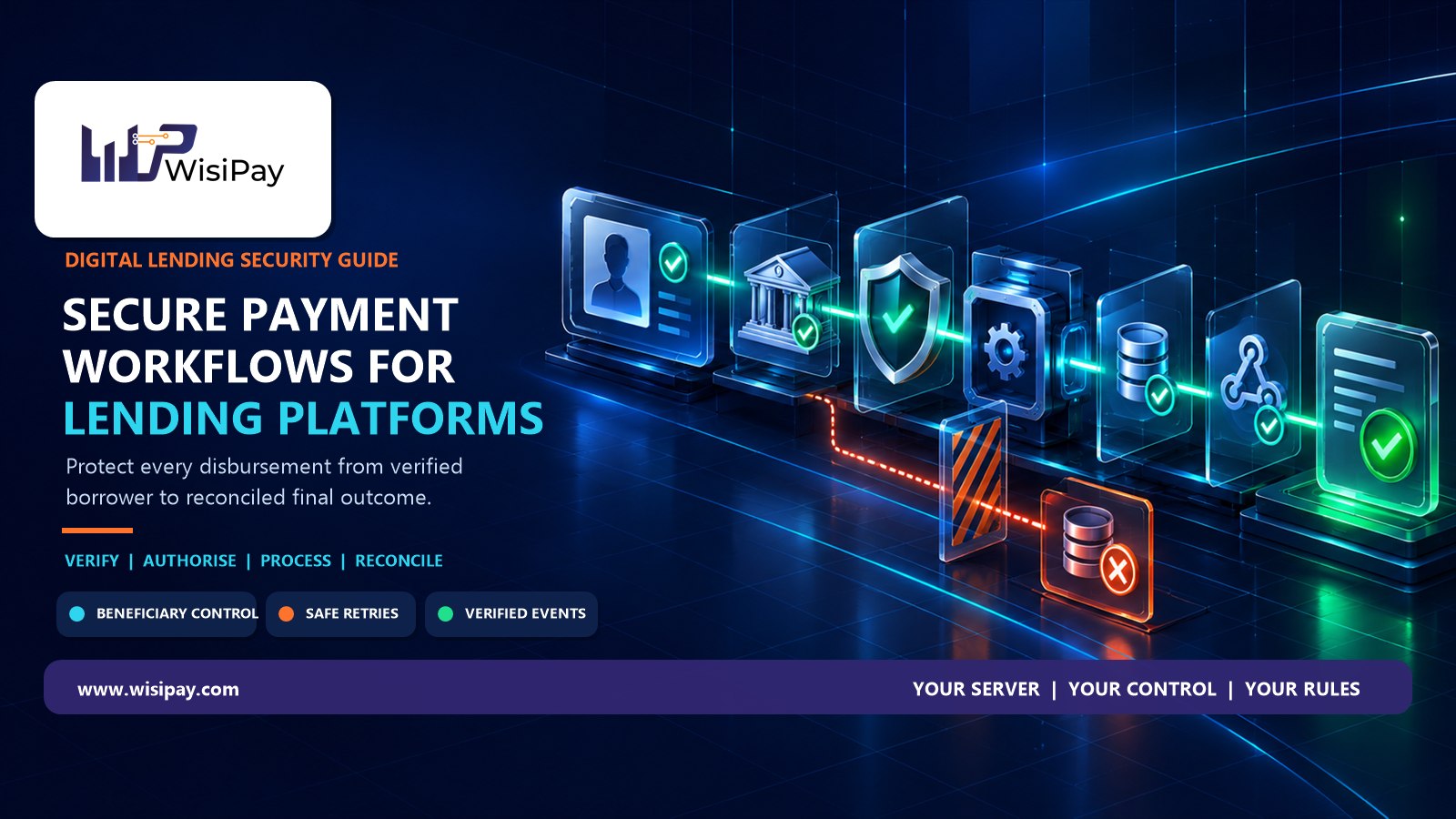
To secure payment workflows in lending platforms, teams need controls across borrower verification, beneficiary management, payment approval, API access, transaction processing and reconciliation. Every disbursement should connect an authorised instruction with a verified destination and a traceable outcome.
Consider a payment request that times out. An operator sees no confirmation and submits it again. The bank then completes both transfers. The borrower receives twice the intended amount, while the lending system still shows one approved disbursement.
Another risk appears when beneficiary details change after approval. The payment can execute successfully while reaching an account the reviewer never checked.
Digital lending payment security therefore needs to cover the complete lifecycle, including failures and manual interventions. This guide explains practical controls for engineering, finance and operations teams, with an example of how those controls work together.
1. Map the Fund Flow and Assign Responsibility
Document the route from loan approval to disbursement and from repayment receipt to ledger update. Identify each system, partner, account and operational team involved.
For Indian lending operations, have the responsible compliance team validate the proposed fund flow against the current requirements applicable to the lender and product. Technical routing should implement that approved arrangement.
| Stage | Control question | Suggested owner |
|---|---|---|
| Borrower onboarding | Is identity verification complete? | Onboarding operations |
| Disbursement approval | Are the amount and destination authorised? | Lending operations |
| Payment execution | Can this instruction be submitted safely? | Payment engineering |
| Reconciliation | Do external and internal records agree? | Finance operations |
Assign exception ownership too. “The integration failed” is a diagnosis, not a resolution process.
2. Verify the Borrower and Control Beneficiary Changes
Customer identity and payment destination are separate checks. Completing KYC does not establish that every bank account subsequently entered belongs to the intended recipient or is an approved destination.
Connect the borrower, loan and beneficiary through stable internal references. Before disbursement, confirm that the selected account matches the reviewed beneficiary record and that relevant verification exceptions are resolved.
For beneficiary changes, define independent verification and approval requirements. Preserve the previous version, the proposed change, the reason and the reviewer’s decision.
A suggested implementation rule is to invalidate payment approval when a material destination change occurs. Test the rule through both the dashboard and integration interfaces.
Decide how teams handle unavailable validation responses or account-name mismatches. Neither an automatic rejection nor an automatic acceptance should replace a documented review policy.
3. Bind Approval to the Exact Payment Instruction
Payment approval should identify the amount, currency, beneficiary, loan reference and transaction version reviewed.
Use role separation where independent review is required. The person preparing a restricted disbursement should not be able to approve it by switching screens or calling another endpoint.
Define approval limits, backup approvers and the conditions requiring fresh review. Include changes to the amount, destination and payment purpose.
OWASP recommends that transaction authorisation lets users acknowledge significant details and that controls are enforced server-side. It also describes restarting authorisation when transaction data changes. Read OWASP’s transaction authorisation guidance.
In a proof of concept, approve one payment version, change a significant field and attempt submission. The result should match the documented policy, with evidence explaining what happened.
4. Restrict What Payment APIs Can Do
Authenticating an integration establishes its identity. Authorisation determines which records and operations that identity can access.
A service that retrieves payment status should not automatically have permission to release funds, change beneficiaries or alter approval settings.
Apply HTTPS, endpoint-level access checks, input validation and appropriately scoped service permissions. OWASP’s REST security guidance also addresses restricting methods and preventing callers from bypassing workflow steps. Review the REST Security Cheat Sheet.
For the lending implementation, reject attempts to access another borrower’s payment through a modified identifier. Validate the approved instruction on the server instead of trusting an amount or approval flag supplied by the client.
Keep test credentials and production access separate. Establish who can revoke a compromised integration and how affected payments will be investigated.
5. Protect Staff Access and Account Recovery
Administrative accounts can affect payment rules, beneficiaries and user permissions. Their protection deserves the same attention as the payment endpoints.
Use individual identities, least-privilege roles and suitable multifactor authentication. OWASP recommends phishing-resistant authenticators where appropriate and explains why independent authentication factors matter. Read its MFA guidance.
Review recovery and emergency-access procedures. A strong normal login process can be undermined by an informal recovery route.
For operational planning, define access reviews after role changes, temporary support permissions and emergency actions. Record who authorised exceptional access and when it expires.
Avoid shared administrator credentials. They make it harder to distinguish legitimate troubleshooting from an unauthorised configuration change.
6. Make Payment Retries Safe
A timeout describes a missing response within a time window. It does not establish that the bank rejected the transfer.
Give each intended disbursement a stable business reference and each processing attempt its own identity. Where supported, follow the provider’s idempotency rules when retrying the same operation.
Stripe’s documentation illustrates how idempotency keys prevent supported retries from repeating an operation. Behaviour varies by API, including key retention and parameter checks. See Stripe’s idempotency documentation.
Implement duplicate controls across the lending platform too. A key recognised by one provider may not protect a second instruction sent through another provider.
For fallback routing, define which failures permit another attempt. An ambiguous original outcome should trigger status checks or review before a different route is used.
Preserve the relationship between attempts so investigators can establish whether one obligation produced more than one transfer.
7. Verify Payment Events Before Updating Loan Records
A payment webhook can trigger a disbursement confirmation or repayment posting. Treat it as an external message that needs verification.
Use the provider’s documented signature-verification method. Match the event with the expected transaction, account context and amount before applying the relevant update.
Handle repeated deliveries and delayed events. Stripe, for example, documents duplicate delivery and does not guarantee event order. Its guidance requires verification before acting on incoming events. Read Stripe’s webhook documentation.
For your workflow, define allowed status transitions and a recovery route for conflicting messages. When necessary, retrieve the current transaction state through the provider’s authenticated interface.
A callback arriving later should not automatically overwrite a more reliable confirmed state.
8. Put Risk Reviews Before Irreversible Actions
Decide which signals require review before payment release. Candidate scenarios include repeated beneficiary changes, unusual submission volumes or a payment request inconsistent with the approved loan record.
These are proposed review scenarios, not proof of fraud. Assess them with customer, transaction and operational context.
For each rule, specify the action: allow, hold, request another approval or refer for investigation. Identify who can resolve the hold and what evidence they must retain.
Avoid accumulating alerts without a response process. A queue needs ownership, prioritisation and a clear distinction between suspected risk and confirmed findings.
Review the rules after real incidents and false positives. Record changes so later investigators can identify which policy applied to an earlier payment.
9. Reconcile Disbursements and Repayments
Reconciliation checks whether the approved obligation, payment records, bank evidence and loan ledger agree.
For disbursements, compare the authorised amount and destination with the submitted instruction and confirmed outcome. For repayments, establish which loan should receive the credit and how reversals or adjustments are represented.
A suggested exception queue should distinguish:
- Unresolved payments beyond the expected processing window.
- Confirmed transfers missing from the loan ledger.
- Amount or reference mismatches.
- Suspected duplicate disbursements.
- Repayments that cannot be allocated confidently.
Give each exception an owner and next action. If the transfer succeeded but the ledger update failed, repair the accounting process rather than sending money again.
Set review frequency according to transaction volume, payment characteristics and the consequences of delayed detection.
10. Retain Useful Evidence Without Logging Secrets
Capture enough information to reconstruct payment decisions: actor references, timestamps, transaction versions, approval outcomes, processing attempts and manual resolutions.
OWASP recommends recording useful event context while protecting logs and excluding sensitive information such as credentials and tokens. Review its logging guidance.
For lending operations, shared references should connect the loan, approved instruction, provider attempt and reconciliation case. Keep sensitive evidence behind appropriate access controls instead of copying unrestricted documents into every event.
Define retention according to applicable obligations and documented policy. Protect earlier events against unauthorised changes and record access to sensitive exports.
Also monitor collection gaps. An apparently complete payment history can be misleading if a connected system stopped sending events.
Example: Handling an Unresolved ₹50,000 Disbursement
Consider this hypothetical sequence.
A lender approves ₹50,000 for a verified borrower and reviewed beneficiary. The platform creates disbursement reference DISB-2041 and submits an instruction through its payment partner.
The response times out. The platform retains an unresolved state and blocks an overlapping release for the same obligation. It queries the original provider instead of immediately switching routes.
The provider later confirms success. A verified event links the external transaction reference to DISB-2041. The lending system attempts its ledger update, but that update fails.
The payment remains confirmed while the accounting exception stays open. Operations repairs the ledger update using the existing reference. Reconciliation then checks the recorded result against the relevant external evidence.
The sequence preserves two important distinctions: an unknown payment outcome is different from failure, and a failed accounting update is different from a failed transfer.
Your implementation should define and test those distinctions before an operator encounters them during a live payment cycle.
Test the Complete Workflow Before Launch
Successful test payments demonstrate the normal path. Add failure and misuse scenarios to establish whether controls work under pressure.
- Change the beneficiary after approval.
- Submit the same disbursement from two workers simultaneously.
- Send a webhook with an invalid signature.
- Deliver the same event repeatedly.
- Complete a transfer after the original request times out.
- Interrupt the ledger update after payment success.
- Remove an employee’s payment role and test remaining access.
For each test, specify whether funds can move, the expected state, the evidence generated and the person responsible for resolution.
Maintain a documented incident procedure for restricting affected access, pausing the relevant workflow and reconciling uncertain transactions before normal processing resumes.
Where WisiPay Fits into Digital Lending Payments
WisiPay’s digital lending offering covers borrower verification, agreement signing, mandate workflows and fraud-risk functions.
WISI PayOrchestrate describes own-server payment orchestration with connected gateways and banking partners, routing, fallback and settlement reporting.
Map the required controls to the proposed deployment. Confirm payment-rail compatibility, integration boundaries, exception handling and which responsibilities remain with the lender and its partners.
Contact WisiPay to discuss your lending workflow, approved fund flow and integration requirements.
Frequently Asked Questions
Is KYC enough to secure loan payments?
No. Identity verification needs to work alongside destination checks, payment authorisation, duplicate controls, confirmation and reconciliation.
Should a timed-out disbursement be retried immediately?
First establish the original outcome and follow the provider’s retry rules. A timeout alone does not establish failure.
Can routing and fallback prevent every payment failure?
No. Outcomes depend on the connected systems and failure conditions. Fallback also needs safeguards against overlapping transfers.
Does a secure integration automatically make the lending workflow compliant?
No. Compliance depends on the applicable requirements, fund flow, contracts, governance, data handling and operational implementation.
Which control should a team implement first?
Start by mapping the existing workflow and identifying where an unauthorised or duplicate transfer could occur. Prioritise controls against those concrete gaps.
manoj
admin