What Is Re-KYC? Process and Documents Explained | WisiPay
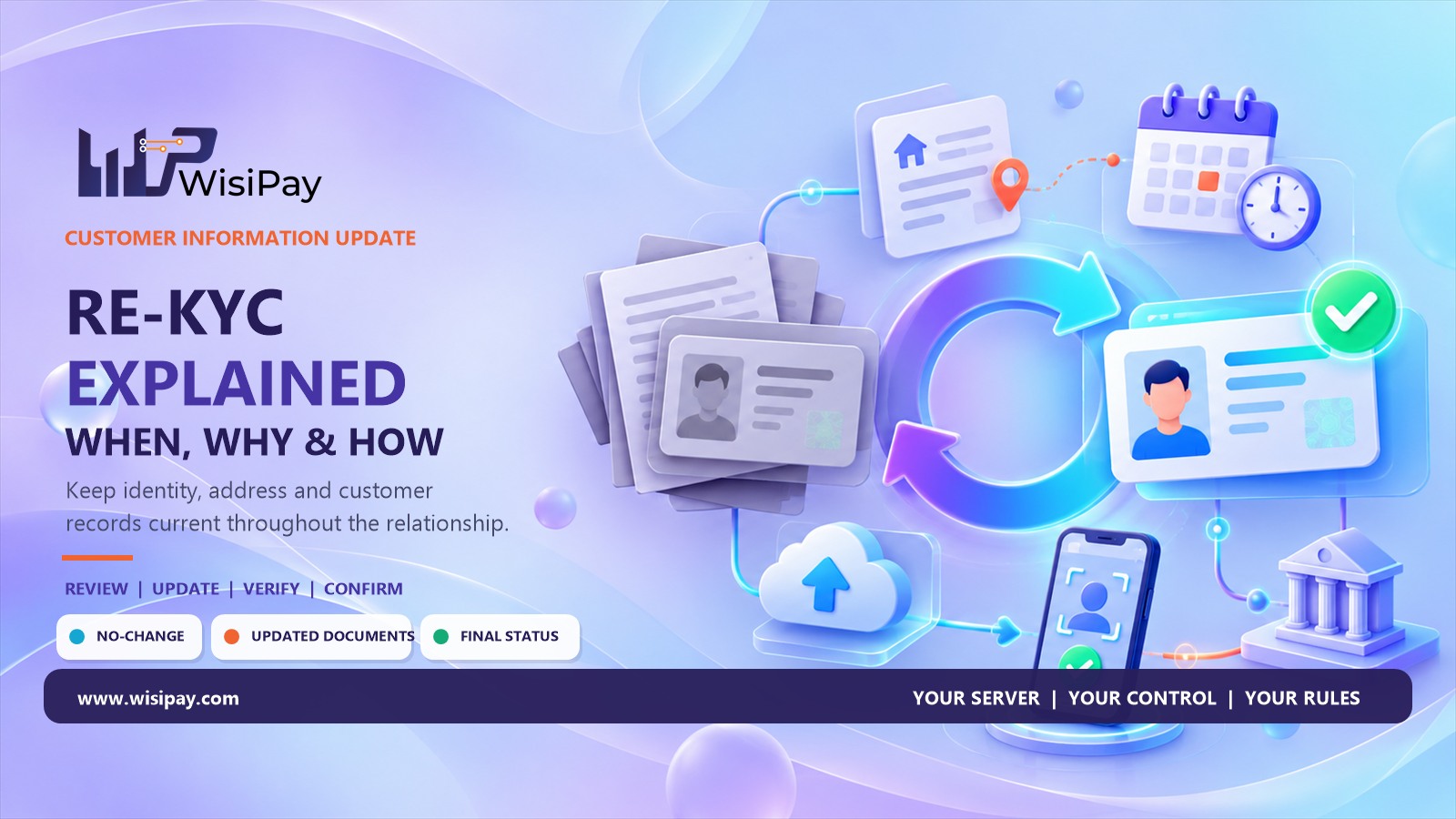
Re-KYC is the process of reviewing and updating the Know Your Customer information a financial institution holds about an existing customer. It helps keep identity, address and other relevant records current after the original account-opening checks.
Receiving a Re-KYC request does not necessarily mean something is wrong with your account. Your periodic review may be due, a document may have expired, or the institution may need updated information.
The steps depend on what has changed and the channels your institution supports. A customer whose information is unchanged may have a different process from someone updating an address or replacing an expired document.
How Is Re-KYC Different from Initial KYC?
Initial KYC establishes the customer’s identity and relevant information when the relationship begins. Re-KYC revisits the information during that relationship.
| Aspect | Initial KYC | Re-KYC |
|---|---|---|
| Purpose | Establish customer identity and required onboarding information | Review whether existing information remains current and sufficient |
| Typical timing | At the start of an account-based relationship | During periodic review or when relevant information needs updating |
| Customer action | Provide the information required for onboarding | Confirm unchanged information or submit the updates requested |
Re-KYC is not the same as applying for a new financial product. It updates the information supporting an existing relationship.
When Is Re-KYC Required?
Periodic KYC review is generally linked to customer risk categorisation. ICICI Bank’s current Re-KYC information describes review intervals of at least once every two years for high-risk customers, eight years for medium-risk customers and ten years for low-risk customers.
Those intervals do not mean you should wait to report a relevant change. Follow the institution’s instructions when your details change or it requests clarification. See ICICI Bank’s Re-KYC information.
Check the due date and requirements in your own institution’s verified notice. Avoid assuming that another person’s deadline or process applies to your account.
What If None of Your KYC Details Have Changed?
If your information is unchanged, a self-declaration may be sufficient through a supported channel, subject to the applicable conditions.
RBI’s customer-awareness guidance lists channels such as online banking, mobile banking, registered contact channels and bank Business Correspondents for a no-change declaration. Your bank can confirm which option is available to you. Read RBI’s Re-KYC guidance.
Review the information before declaring that nothing has changed. An old address or expired document should not be confirmed as current simply to complete the request quickly.
Which Documents May Be Needed for Re-KYC?
For individual customers, the institution may request an Officially Valid Document, PAN or Form 60 where applicable, and additional information relevant to its checks.
Examples of officially valid documents include a passport, driving licence, proof of possession of Aadhaar number and voter’s identity card. Requirements differ for non-individual customers and particular account categories. Review ICICI Bank’s document guidance.
Use your institution’s current checklist rather than submitting every identity document you hold. Ask which evidence is needed for the specific change and whether originals, copies or supported digital documents are required.
RBI’s Re-KYC awareness page also explains that changed details should be supported through the appropriate updated-document process.
How to Complete the Re-KYC Process
1. Verify the request
Open your institution’s official app or website independently, or contact it using a verified service number. Confirm that a Re-KYC request is outstanding.
2. Check what needs updating
Establish whether the request concerns unchanged information, an address change, an expired document or another discrepancy. This helps you choose the correct route.
3. Use a supported submission channel
Follow the process offered for your customer category. Digital and branch options vary. For example, ICICI Bank lists online channels, eligible video verification and branch-based routes on its Re-KYC pages.
4. Review before submitting
Check that names, dates and address details agree with the supporting evidence. Make sure uploaded copies are readable and that the requested pages are included.
5. Keep the acknowledgement
Retain the reference number or confirmation provided. Submission and successful completion are different stages, so check the final status if the request remains under review.
What If Your Re-KYC Request Is Not Completed?
Ask for the specific reason before submitting the same documents again.
| Issue | Suggested next step |
|---|---|
| Unreadable document | Provide a clear copy through the verified submission channel |
| Information mismatch | Ask which field differs and what correction evidence is accepted |
| Expired document | Request the current replacement-document checklist |
| Digital authentication unavailable | Ask about an alternative supported route |
| Request remains pending | Follow up using the existing acknowledgement reference |
Keep a record of the explanation and next action. This makes follow-up easier if the request moves between service teams.
What Happens If Re-KYC Is Overdue?
The consequences depend on the applicable requirements, customer category and circumstances. Do not assume that every overdue request leads to an immediate account restriction.
RBI’s June 2025 amendment introduced specific treatment for low-risk individual customers, including continued transactions within the prescribed update window. Institutions must apply the current requirements relevant to them. Read the RBI amendment.
If you receive a restriction notice, contact the institution promptly. Ask what remains incomplete, which process applies and how completion will be confirmed. Avoid relying on a generic deadline circulated online.
How Banks and NBFCs Can Make Re-KYC Easier to Manage
A practical Re-KYC workflow should separate customer communication, submission, verification and closure.
For implementation planning, teams can track:
- The reason and applicable due date for the review.
- Customer notices and delivery outcomes.
- The chosen submission route.
- Declarations and document references received.
- Discrepancies requiring a reviewer.
- The decision, reviewer and completion confirmation.
Test both straightforward and exception cases. A workflow should explain what happens when details are unchanged, a document is unclear or a customer cannot use the usual digital channel.
Keep the customer-facing request specific. “Please update your expired identity document” gives a clearer next action than a repeated general reminder to complete KYC.
Where WISI Verify Fits
WISI Verify offers KYC, CKYC, DigiLocker and other verification APIs for financial onboarding, with logged verification responses.
Institutions assessing it for customer-update workflows should confirm which checks and integrations fit their Re-KYC process. Review reminders, declarations, exception handling and closure requirements separately rather than assuming they are all included in a verification API.
Contact WisiPay to discuss how verification services could connect with your institution’s customer lifecycle.
Frequently Asked Questions
What does Re-KYC mean?
It means reviewing and updating the KYC information held for an existing customer so it remains current and relevant.
Can Re-KYC be completed online?
It may be possible, depending on the institution, customer category and changes required. Check the options within the official app or website.
Do I always need to visit a branch?
No. Supported alternatives may be available. Ask your institution which route applies to your request.
Is Aadhaar the only document accepted?
No. Other officially valid documents can be relevant. Use the current checklist supplied by your institution for your circumstances.
Does having a CKYC number remove the need for Re-KYC?
A CKYC identifier does not establish that all information remains current. Confirm how your institution uses registry records in its update process.
How long does Re-KYC take?
There is no single completion time for every institution and case. Ask for the expected timeframe and use the acknowledgement reference to track progress.
Manoj
admin