**26 October – 1 November 2026 | Wisi Pay Research**
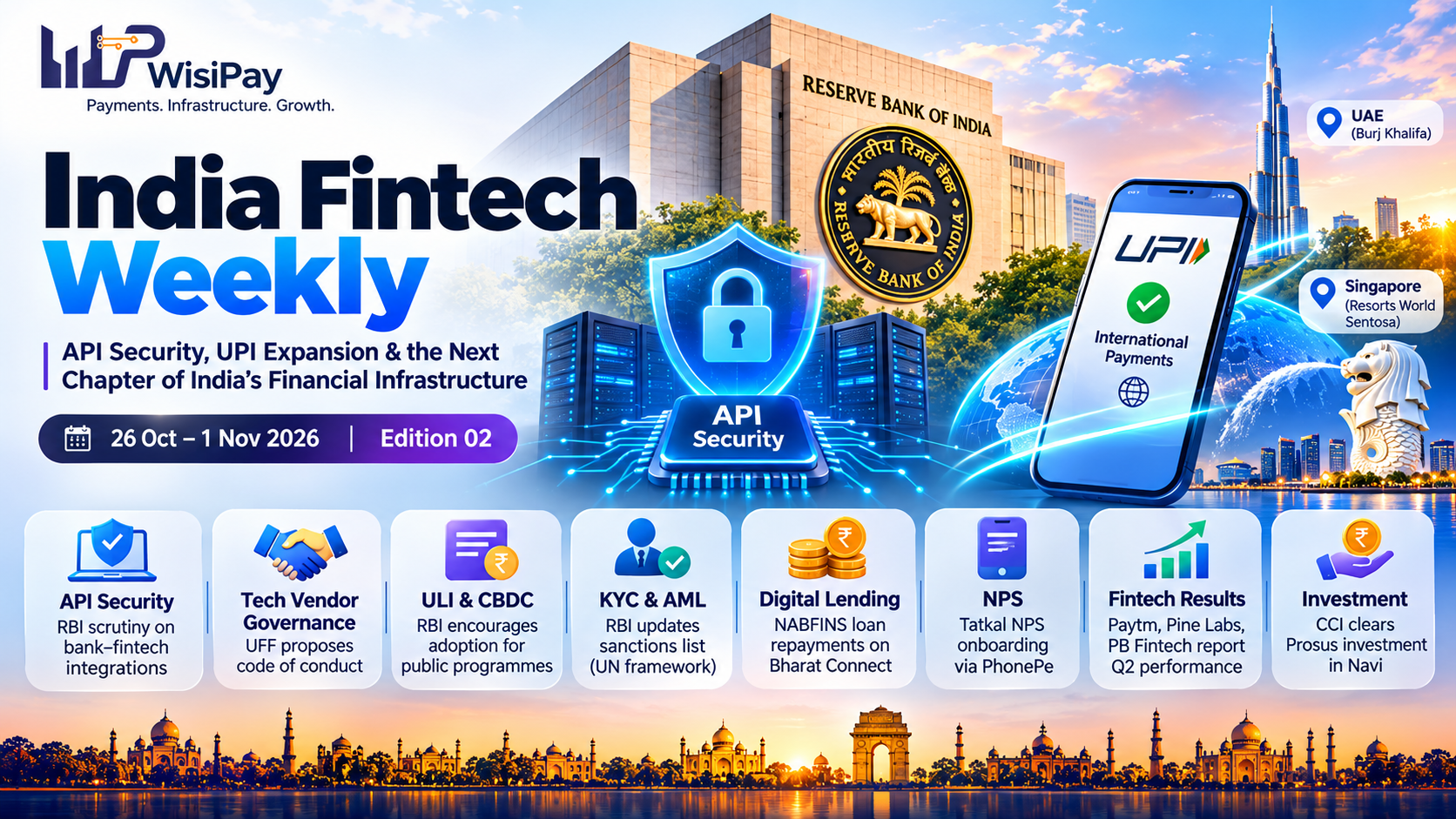
India's fintech industry is entering a more demanding phase of growth.
Digital adoption, faster payments and connected financial services continue to create new opportunities. But this week's developments point to a deeper question:
**As financial systems become more connected, how do institutions ensure that every transaction is secure, authorised, traceable and operationally reliable?**
From renewed scrutiny of bank–fintech API security to UPI's international expansion, digital lending, regulatory developments and payment-industry earnings, the focus is increasingly shifting from connectivity alone to the quality of the infrastructure behind it.
Here are **10 developments shaping India's fintech ecosystem this week.**
---
1. Bank–Fintech API Security Comes Under Renewed Scrutiny
**30 October 2026 | Cybersecurity & Payment Infrastructure**
The Reserve Bank of India has reportedly intensified its scrutiny of cybersecurity practices at banks, with particular attention to API connections involving fintech companies and non-banking financial institutions.
According to reporting published on 30 October, supervisory attention includes evidence of compliance with existing cybersecurity standards, third-party connectivity and preparedness for emerging threats.
The development follows reports of unauthorised financial transactions involving compromised API access.
Importantly, this is reported supervisory scrutiny—not the announcement of a new universal RBI cybersecurity circular.
**Why it matters:**
Payment infrastructure depends on more than authenticated API credentials.
Financial institutions need independent transaction authorisation, beneficiary verification, approval controls, transaction limits, anomaly detection and reconciliation.
A technically successful API request does not necessarily mean that the underlying financial instruction was legitimate.
**Source:** The Economic Times — RBI Cybersecurity Scrutiny
**Technical reference:** CERT-In Advisory CIAD-2026-0046 — issued 9 October 2026, included as earlier background rather than new weekly guidance.
2. Industry Framework Proposed for Fintech Technology Vendors
**30 October 2026 | Technology Governance & Compliance**
The Unified Fintech Forum (UFF), an RBI-recognised fintech self-regulatory organisation, is reportedly developing a code of conduct for technology service providers and RegTech companies.
The proposed framework focuses on areas including cybersecurity preparedness, operational resilience, governance and accountability.
Technology providers increasingly support critical financial operations such as customer onboarding, loan processing, payment connectivity, transaction monitoring and regulatory reporting.
**Why it matters:**
The reliability of a financial institution increasingly depends on the quality of its external technology partners.
Vendor security assessments, documented controls, incident-response capabilities and clear contractual responsibilities may become more important in technology procurement.
The framework remains under development. It should not be interpreted as a new mandatory RBI licensing requirement for all fintech technology providers.
**Source:** The Economic Times — Proposed Technology Vendor Code
3. RBI Governor Encourages ULI and Programmable CBDC Adoption
**27 October 2026 | Digital Public Infrastructure**
At the 36th Conference of State Finance Secretaries, RBI Governor Sanjay Malhotra encouraged state governments to explore the Unified Lending Interface (ULI) and programmable central bank digital currency for direct benefit transfers.
ULI aims to improve the exchange of relevant information within lending workflows, while programmable CBDC offers possibilities for purpose-specific digital payments.
These are distinct technologies serving different financial use cases.
The Governor's remarks represent recommendations for exploration—not mandatory nationwide implementation.
**Why it matters:**
The next generation of financial infrastructure may connect lending data, beneficiary verification, payment execution and programme-level controls more closely.
For financial institutions and government programmes, successful implementation will require secure integrations, transparent fund flows and reliable transaction records.
**Source:** RBI — Conference of State Finance Secretaries
4. RBI Sanctions-List Updates Reinforce the Importance of AML Data Accuracy
**27 October 2026 | KYC, AML & Regulatory Compliance**
The RBI issued notices concerning updates to the United Nations ISIL/Al-Qaida sanctions list under the applicable UAPA-related compliance framework.
The updates included the removal of three entries following a UN action dated 26 October and amendments to three other entries.
These are different types of changes: removal of an entry is not the same as modification of an existing record.
**Why it matters:**
Effective AML monitoring requires more than periodically running customer names through a screening system.
Financial institutions need accurate list updates, re-screening workflows, exception handling, version history and defensible audit records.
For technology providers supporting regulated entities, maintaining reliable sanctions-data integration and traceability is essential.
**Official sources:**
The detailed official attachments should be reviewed before implementing screening-data changes.
5. Bharat Connect Expands Digital Microfinance Loan Repayments
**28 October 2026 | Payments & Digital Lending**
NPCI Bharat BillPay Limited announced the onboarding of NABARD Financial Services (NABFINS) into Bharat Connect's Loan Repayment category.
According to the announcement, the integration enables more than one lakh NABFINS borrowers across 19 states to make repayments through over 1,000 enabled banking and payment applications and approximately eight lakh agent outlets.
Canara Bank facilitated the onboarding as the Biller Operating Unit.
**Why it matters:**
Interoperable repayment infrastructure can improve accessibility for borrowers, especially where assisted digital channels remain important.
However, a successful collection experience also depends on accurate loan identification, payment confirmation, reconciliation and timely exception resolution.
As digital lending expands, the infrastructure supporting repayments becomes as important as the technology enabling loan disbursement.
**Source:** NBBL Announcement — NABFINS on Bharat Connect
6. PhonePe Introduces Digital NPS Onboarding Through Existing Bank KYC
**27 October 2026 | Digital KYC & Financial Inclusion**
PhonePe announced a Tatkal NPS onboarding experience in partnership with banks, enabling eligible users to open pension accounts through a paperless process using existing bank KYC information.
The company said the journey supports OTP-based authentication, faster Permanent Retirement Account Number generation and initial contributions starting at ₹250.
This is a new distribution experience built around an existing regulatory framework—not a general exemption from KYC requirements.
**Why it matters:**
Digital financial services increasingly benefit from secure reuse of previously verified customer information.
When implemented with appropriate consent, authentication and auditability, identity reuse can reduce onboarding friction without sacrificing compliance.
**Source:** PhonePe — Official Tatkal NPS Announcement
7. UPI's International Reach Expands Through Tourist Booking Payments
**30 October 2026 | Cross-Border Payments**
A Ministry of Finance announcement highlighted UPI payment acceptance for eligible online tourist bookings involving At the Top, Burj Khalifa in the UAE and Resorts World Sentosa in Singapore.
The underlying partnerships had been announced earlier, on 29 July and 9 September respectively. The official release dated 30 October brought renewed attention to these international acceptance arrangements.
This should not be interpreted as universal UPI acceptance at every physical merchant location in either destination.
**Why it matters:**
Cross-border UPI acceptance demonstrates how India's domestic payment infrastructure can support international commerce through partnerships with local acquiring and payment-service ecosystems.
For the industry, important considerations include merchant integration, foreign-exchange handling, settlement visibility, transaction reporting and reconciliation.
**Source:** Press Information Bureau — International UPI Acceptance
8. RNFI Receives RBI No-Objection for Proposed PPI Acquisition
**29 October 2026 | Payments M&A & Regulatory Approvals**
RNFI Services disclosed that the RBI had granted a no-objection concerning its proposed acquisition of, and change in control at, Smart Payment Solutions, an authorised prepaid payment instrument issuer.
The company disclosed the regulatory development through an exchange filing dated 29 October.
The filing does not establish that the acquisition has already closed, nor does it disclose a confirmed transaction value.
**Why it matters:**
Acquiring regulated payment capabilities can provide opportunities to expand financial-product distribution and infrastructure.
However, regulatory approval, transaction completion and operational integration are separate milestones.
Payment businesses must continue to address licensing scope, technology integration, transaction controls and customer-fund responsibilities.
**Source:** RNFI — Official NSE Disclosure (PDF)
9. Fintech Financial Results Highlight the Importance of Sustainable Growth
**26–30 October 2026 | Payments, Lending & Financial Performance**
Several Indian fintech businesses reported their September-quarter financial results during the week.
**Paytm** reported approximately ₹2,648 crore in quarterly revenue and ₹225 crore in profit after tax, alongside growth in merchant payments and financial-services distribution.
**Pine Labs** reported approximately ₹806.2 crore in quarterly operating revenue and ₹38.6 crore in profit, according to its results coverage.
**PB Fintech**, the parent of Policybazaar and Paisabazaar, reported approximately ₹2,177.71 crore in consolidated quarterly revenue and ₹192.45 crore in net profit.
These figures describe financial performance for the quarter ended September 2026—not revenue or profit earned during this reporting week.
**Why it matters:**
The sector's performance increasingly needs to be evaluated through profitability, operating efficiency, customer engagement and the quality of underlying transaction and distribution infrastructure.
Growth in payment volume alone does not establish sustainable unit economics.
**Sources:**
10. CCI Clears Proposed Prosus Investment in Navi
**30 October 2026 | Fintech Investment & Regulatory Approval**
The Competition Commission of India approved the proposed acquisition of a minority shareholding in Navi by MIH Payments Holdings, part of the Prosus group.
The approval relates to a previously announced investment associated with approximately $100 million in funding.
Importantly, the CCI approval is a regulatory milestone. It does not independently establish that the investment transaction has been completed.
**Why it matters:**
Capital continues to flow toward fintech businesses operating in lending and financial distribution.
But investors and strategic partners increasingly need to evaluate regulatory readiness, portfolio quality, operational infrastructure and long-term business sustainability alongside growth potential.
**Source:** Competition Commission of India — Official Approval
---
Wisi Pay Research | The Bigger Picture
Three structural trends stand out from this week's developments.
1. API security is becoming a core financial control
As banks, fintechs and technology providers connect through APIs, technical authentication alone is insufficient.
Institutions increasingly need to establish who authorised a transaction, whether it complied with applicable controls, how it was executed and whether the final financial outcome was reconciled.
Security, transaction governance and operational accountability must work together.
2. Connected financial infrastructure is creating new opportunities
ULI, programmable CBDC, Bharat Connect, digital KYC reuse and cross-border UPI acceptance demonstrate the growing relevance of interconnected financial services.
The challenge is no longer simply integrating more systems.
It is ensuring that those systems exchange information securely while preserving transaction visibility, business controls and accountability.
3. Operational resilience and sustainable economics are gaining importance
Technology-vendor governance discussions, cybersecurity scrutiny, fintech earnings and investment developments all reinforce a broader industry direction.
Financial institutions increasingly need dependable infrastructure that supports growth without introducing unnecessary operational complexity or uncontrolled risk.
What This Means for Banks, Fintechs and Merchants
**For banks and regulated financial institutions:** Stronger API governance, independent transaction controls, third-party risk assessments and reliable reconciliation are essential.
**For fintech companies:** Scalable financial products require secure integrations, intelligent monitoring, clear transaction states and transparent operational processes.
**For merchants:** Reliable payment acceptance must be supported by accurate settlement visibility, exception handling and reconciliation.
**For technology providers:** Product capabilities increasingly need to be accompanied by demonstrable security, resilience, auditability and clearly defined responsibilities.
Wisi Pay Research Perspective
At Wisi Pay, we believe the next phase of payment infrastructure will be defined by the ability to connect financial systems while preserving operational control.
Payment orchestration should go beyond connecting multiple payment providers.
It should help institutions manage transaction routing, approvals, monitoring, status visibility, reconciliation and exceptions through a coherent technology architecture.
Client-controlled deployment models can offer additional flexibility in infrastructure management and system integration, while the actual regulatory and operational responsibilities remain dependent on each participant's role.
Our perspective is simple:
**The future of Indian fintech is not just about enabling more transactions. It is about ensuring that every transaction is authorised, intelligently managed, securely executed and fully accountable.**
Looking Ahead
In the coming week, Wisi Pay Research will monitor further RBI and NPCI developments, potential updates on fintech technology-vendor governance, UPI pricing discussions, payment cybersecurity, cross-border acceptance and digital lending infrastructure.
We will also watch how financial institutions translate security expectations into practical controls across their technology ecosystems.
India's fintech growth story remains compelling.
But sustainable progress will depend on building infrastructure that is not only innovative and scalable, but also secure, transparent and resilient.
**India Fintech Weekly** is a weekly research series by **Wisi Pay**, covering developments shaping India's financial technology ecosystem.
*Research note: Developments have been selected from the India Fintech Intelligence Master News Archive and attributed to the linked sources. Company-reported figures, policy discussions and regulatory approvals are distinguished from independently confirmed outcomes. Industry interpretations represent Wisi Pay Research perspectives and do not constitute legal, regulatory or investment advice.*
#IndiaFintech #FintechNews #DigitalPayments #RBI #UPI #Cybersecurity #PaymentOrchestration #DigitalLending #WisiPay
Avinash
admin