What Is CKYC? Meaning, Number and Process | WisiPay
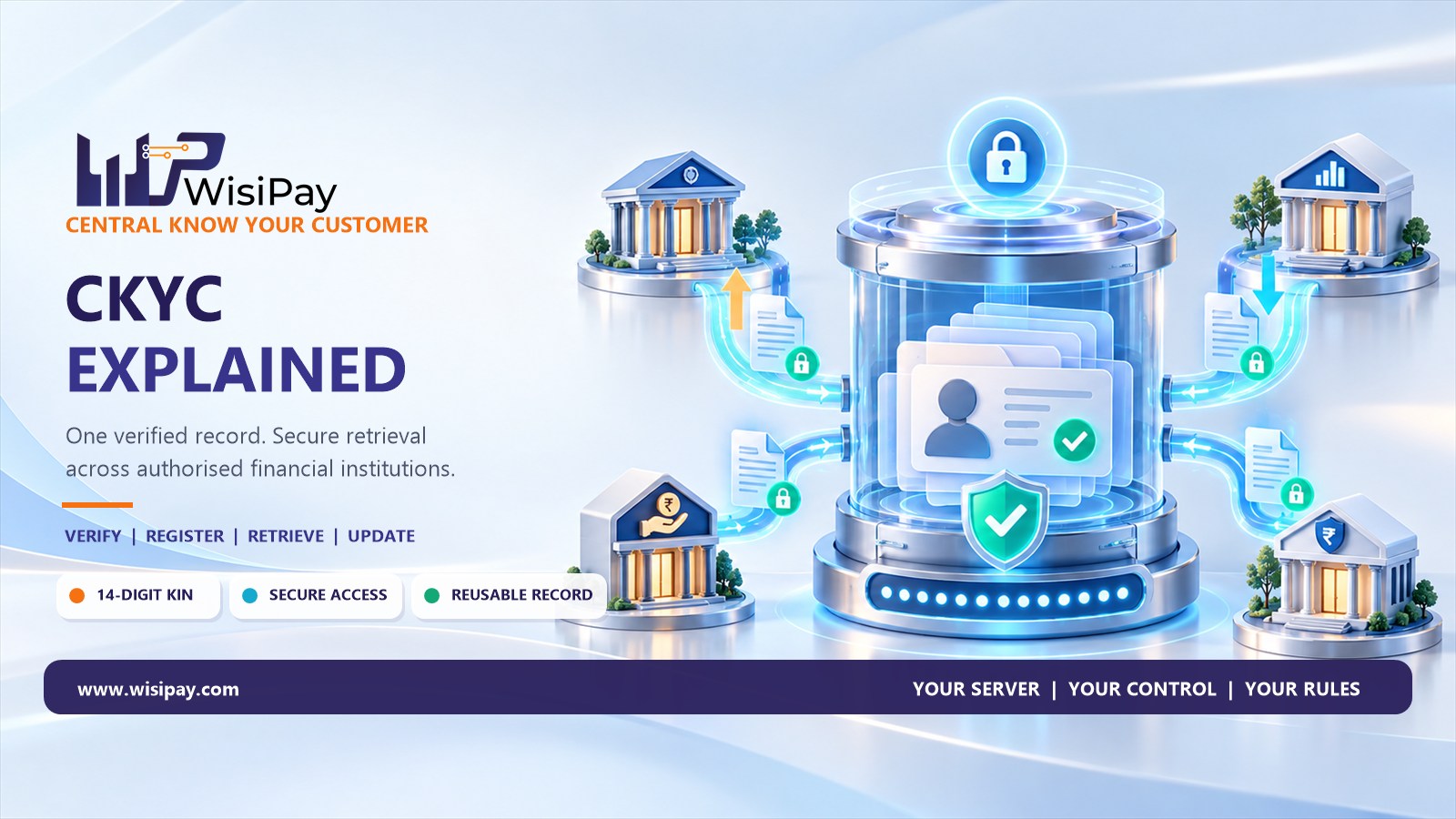
CKYC stands for Central Know Your Customer. It is a centralised system for storing customer KYC records so eligible financial institutions can retrieve those records through an authorised process instead of collecting the same information repeatedly.
After successful registration, an individual receives a 14-digit KYC Identifier, commonly called a CKYC number or KIN. This number identifies the customer’s record in the Central KYC Records Registry.
For example, someone who has completed KYC with one financial institution may already have a CKYC record when approaching another. The receiving institution can use the applicable retrieval process and review whether the information meets its requirements.
CKYC can reduce repeated paperwork. It does not mean that every future financial application will be approved or that customer information never needs updating. SBI Card’s CKYC FAQ explains the central record and identifier.
Who Manages the Central KYC Records Registry?
The Central KYC Records Registry is managed by CERSAI, the Central Registry of Securitisation Asset Reconstruction and Security Interest of India.
The registry receives and maintains KYC records submitted through participating reporting entities. It is different from the bank, lender, insurer or other institution providing the financial product.
This distinction matters: a CKYC record supports customer identification, while the institution remains responsible for the checks and decisions applicable to its own customer relationship.
More information is available through the official CKYC website.
What Is a CKYC Number?
A CKYC number is the identifier associated with a registered KYC record. For individuals, it is commonly described as a 14-digit KIN.
It is separate from your PAN, Aadhaar number, bank account number and customer ID. These identifiers serve different purposes and should not be used interchangeably on an application form.
| Identifier | Purpose |
|---|---|
| CKYC number or KIN | Identifies a record in the Central KYC Records Registry |
| PAN | Identifies a taxpayer within India’s PAN system |
| Aadhaar number | Identifies an individual within the Aadhaar system |
| Bank account number | Identifies a particular account with a bank |
When an institution requests your CKYC number, use its verified application or service channel. A CKYC identifier should not be treated as a public reference to share unnecessarily.
How Does the CKYC Process Work?
The process generally connects customer verification, registry registration and subsequent retrieval:
- The customer provides information: A financial institution collects the details and documents needed for the applicable KYC process.
- The institution verifies the record: It reviews the submitted information and resolves relevant discrepancies.
- The record is submitted: The reporting entity uploads the verified information through its authorised registry workflow.
- An identifier is generated: Following successful registration, the CKYC record is associated with a KYC Identifier.
- The record can be retrieved later: An eligible institution follows the applicable authorisation, consent and retrieval requirements.
CERSAI’s CKYC operating guidelines describe registry operations and identifier generation. Institutions should check the latest applicable instructions when implementing a workflow.
How Can You Find Your CKYC Number?
Start with a financial institution where you have completed KYC. Ask whether your record has been registered and how to retrieve the identifier through its official channels.
You can also visit the official CKYC website to check the available customer services. Use the current instructions displayed there rather than relying on screenshots or steps from an older article.
IDFC FIRST Bank’s CKYC information page lists retrieval options, including the CKYC portal and supported customer channels. Availability and authentication steps can vary.
If you cannot retrieve a record, ask the institution to investigate. A failed lookup does not establish that a new registration is the correct next step.
What Documents Are Needed for CKYC?
Requirements depend on the customer type, onboarding method and applicable rules. For an individual, the institution may request identity and address evidence, PAN or the applicable alternative, a photograph and other required information.
Companies and other non-individual customers can require a different set of records, including constitution and authorised-person information.
Ask the institution for its current checklist. Do not assume that one document list applies to every customer, product or verification route.
Can an Institution Ask for Documents After Retrieving CKYC?
Yes. Reusing an existing record does not remove every reason for further verification.
RBI’s published KYC amendment explains circumstances in which additional information may be needed, including changed customer details, incomplete records, expired documents and checks needed for identity, address or enhanced due diligence. Read the RBI notification.
For customers, the practical step is to ask what specific information is missing or needs updating. For institutions, the operational priority is to record the reason and route the request through the applicable current process.
How Do You Update Incorrect or Outdated CKYC Details?
Contact your bank or another financial institution handling your KYC record. Explain which details need correction and provide the supporting information it requests.
The institution reviews the change and submits the relevant update through its authorised process. Keep the service reference so you can follow up if the correction is not reflected.
Changing a detail in one application screen does not, by itself, prove that every connected record has been updated. Ask which records were changed and how completion will be confirmed.
Financial institutions should also handle registry update notifications and review their own customer records under the current requirements applicable to them.
What Should Banks and NBFCs Check in a CKYC Workflow?
A useful implementation needs clear handling for unsuccessful results as well as successful retrievals. Before rollout, teams should define:
- How the customer and registry record are matched.
- How consent and the purpose of retrieval are recorded where required.
- Who reviews incomplete or mismatched information.
- How updates and unsuccessful submissions are tracked.
- Which users can view, download or export sensitive records.
- What evidence is retained for operational review.
For a practical test, try a record with an old address, a failed retrieval and a corrected submission. The team should be able to explain the next action and its owner in each case.
Where WISI Verify Fits into CKYC Onboarding
WISI Verify offers KYC, CKYC, DigiLocker and other verification APIs for financial onboarding. Its product information includes CKYC workflow management, download and upload workflows, and logged verification responses.
During evaluation, discuss your institution’s permitted access, customer matching, consent requirements and exception handling. Integration should support the institution’s responsibilities rather than be treated as automatic compliance approval.
Contact WisiPay to review how CKYC workflows could connect with your customer onboarding process.
Frequently Asked Questions
What is the full form of CKYC?
CKYC stands for Central Know Your Customer. It refers to the centralised system used to maintain reusable customer KYC records.
Are CKYC number and KIN the same?
In common customer-facing usage, CKYC number and KIN refer to the KYC Identifier associated with the registry record.
Does having a CKYC number guarantee a loan or account approval?
No. The identifier relates to a KYC record. Product eligibility, risk assessment and approval remain separate decisions.
Does CKYC replace Re-KYC?
No. A central record does not remove the need to keep customer information current or meet applicable periodic review requirements.
What should I do if my CKYC details are wrong?
Contact the financial institution handling your KYC, request a correction through its official process and retain the service reference for follow-up.
Can any website retrieve a CKYC record?
No. Registry access is not a public search service for arbitrary customer records. Use authorised institutional channels and official customer services.
Ak Singh
admin