Treasury Payment Audit Trails: Buyer’s Checklist | WisiPay
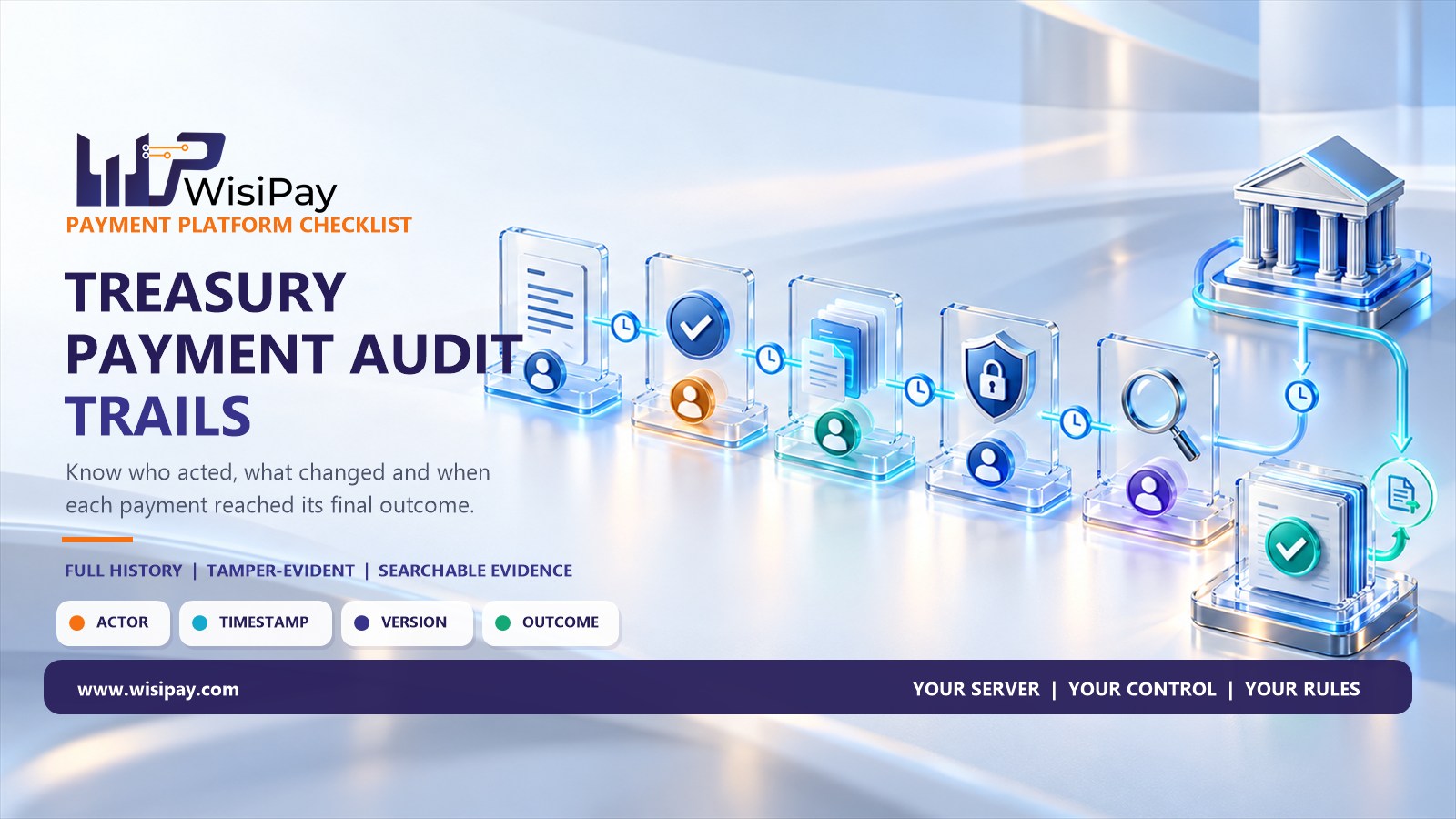
Audit trails for treasury payments should connect the original payment request, the details reviewed by each approver, any subsequent changes and the confirmed payment outcome. A useful record lets your team reconstruct a transaction without searching through separate emails, screenshots and banking reports.
Imagine a treasury manager investigating a supplier payment. The dashboard shows that the payment was approved and completed. However, the supplier says the funds went to the wrong account.
The investigation now depends on more specific evidence: which beneficiary was displayed during approval, whether someone changed it afterwards, who submitted the instruction and what the bank processed.
A status marked “approved” cannot answer those questions on its own. This checklist explains what to ask when evaluating payment platforms and audit logging capabilities.
1. Check Whether the Trail Covers the Full Payment Lifecycle
Ask providers to demonstrate one transaction from creation through approval, submission and resolution. Include an exception rather than reviewing only a successful payment.
| Stage | Evidence to request |
|---|---|
| Payment creation | Creator, time, amount, currency, beneficiary reference and business purpose |
| Review and approval | Approver identity, decision, transaction version and applicable approval rule |
| Payment changes | Changed fields, previous and revised values where appropriate, actor and reason |
| Submission | Submitting service or user, payment reference, destination provider and response |
| Exceptions | Rejections, unresolved outcomes, retries, overrides and investigation actions |
| Resolution | Confirmed outcome, reconciliation result and supporting references |
These are recommended evaluation requirements. Your final event coverage should reflect the payment workflow and risks your organisation needs to review.
2. Establish Exactly What Was Approved
An approval event should identify the transaction details the reviewer authorised. Ask whether the evidence includes the amount, beneficiary, payment reference and version presented for review.
Then test a change after approval. If someone edits the destination account, does the system require another review? Can an investigator distinguish the earlier approved instruction from the revised one?
OWASP’s transaction authorisation guidance recommends showing users significant transaction details, protecting those details from modification and enforcing authorisation on the server. These principles provide useful questions for a payment platform demonstration. Read OWASP’s transaction authorisation guidance.
Remember that recording an approval and enforcing an approval are separate capabilities. An audit log can document a decision without necessarily preventing an unauthorised payment. Evaluate both.
3. Ask What “Immutable” Means in the Proposed Setup
Providers may describe their records as immutable, append-only or tamper-evident. Ask them to explain the technical scope and administrative boundaries behind those terms.
- Append-only: New events are added while earlier entries are not updated through the normal application workflow.
- Tamper-evident: The design provides a way to detect changes to protected records.
- Immutable retention: Protected records cannot be changed or deleted during a defined retention period within the specified storage controls.
These descriptions are not interchangeable guarantees. A platform might prevent ordinary users from editing events while an administrator still controls the underlying database or retention settings.
Request an explanation of privileged access, deletion permissions, storage protection and integrity verification. If cryptographic checks are offered, ask for a demonstration showing how a reviewer detects a changed or missing record.
Also ask how corrections work. A controlled design should preserve the earlier event and link a correction to it, rather than silently replacing history.
4. Follow One Payment Across Connected Systems
Treasury workflows can span an ERP, approval service, payment platform and bank. Records from each system need enough shared references to reconstruct the same transaction.
Ask how the provider distinguishes:
- The business obligation being paid.
- The approved payment instruction.
- Each submission or retry attempt.
- The external bank or payment-provider reference.
- The eventual reconciliation result.
A retry should remain connected to the original payment without obscuring that another attempt occurred. Likewise, a batch approval should retain the item-level details needed to establish which payments were included.
Check timestamp handling as well. Investigators should understand the difference between when an event occurred and when a connected system received or recorded it.
5. Review Access to Logs and Sensitive Information
Payment evidence can contain commercially sensitive information. Review who can search, export or administer it, and whether those actions are themselves recorded.
OWASP’s logging guidance recommends capturing useful event context while excluding secrets and protecting sensitive data. It also addresses log access, tamper detection and retention. Read OWASP’s logging guidance.
For your evaluation, request examples of role permissions and masked views. An operations user may need transaction context without access to every beneficiary detail. An auditor may need read-only access without payment execution rights.
Ask how credentials, authentication tokens and unnecessary personal information are prevented from entering logs. Review exports too: a protected dashboard does not help if its download exposes unrestricted data.
6. Test Search and Exports with an Investigation Task
Give the provider a realistic question: “Show every payment where the beneficiary changed after the first approval during this period.”
Ask them to locate the relevant records, reconstruct a transaction and export the supporting evidence. This reveals more than a demonstration of a general activity feed.
Check whether the exported material preserves actor identities, timestamps, transaction references, event ordering and the filters used. Where integrity verification is available, confirm how it works outside the dashboard.
Also establish which events the platform cannot capture. A bank action or ERP edit outside the integration may require separate evidence. Coverage gaps should be documented rather than hidden behind a claim of a complete audit trail.
7. Confirm Retention, Recovery and Exit Arrangements
Set retention requirements according to the obligations applicable to your organisation and records. A vendor’s default period does not determine what your business needs.
Ask how retention changes are authorised, when deletion occurs and how relevant records can be preserved during an investigation. Confirm recovery arrangements and whether restored data retains the references needed to follow transaction history.
Include an exit question: if the contract ends, can your organisation retrieve the required history in a usable format? Establish the scope, timing and cost before procurement.
A Practical Audit Trail Demonstration Checklist
Use the following scenarios during a proof of concept. Record the evidence produced and any dependencies on other systems.
| Scenario | What the demonstration should establish |
|---|---|
| A beneficiary changes after approval | The change and its effect on the earlier approval are visible |
| A payment request times out and is retried | Both attempts link to the original payment and their outcomes remain distinguishable |
| An administrator changes a logging setting | The privileged action is recorded and its impact can be reviewed |
| A connected system stops sending events | The collection gap is detectable and recovery behaviour is explained |
| A reviewer exports transaction evidence | The export is usable, appropriately restricted and attributable |
Where WisiPay Audit Logs Fits
WisiPay Audit Logs describes immutable, searchable trails for platform actions, API calls and decisions, with actor capture, tamper-evident records, configurable retention and exports.
For a treasury payment use case, confirm which approval events and connected-system activities your implementation captures. Ask how transaction references, privileged access and exported evidence work in the proposed deployment.
Contact WisiPay to discuss your payment workflow and request a demonstration using the investigation scenarios above.
Frequently Asked Questions
What is an audit trail for treasury payments?
It is a linked history of payment preparation, changes, approvals, submission and outcome. It helps reviewers establish who acted and what happened to a specific payment.
Are payment status reports enough for an audit?
A status report may show an outcome without the approval history or transaction changes behind it. The evidence needed depends on the review, but a lifecycle trail provides additional context.
Do immutable logs prevent payment fraud?
They can support accountability and investigation. Prevention also depends on controls such as access restrictions, beneficiary verification, approval enforcement and monitoring.
Which providers offer immutable audit trails for treasury approvals and payments?
Evaluate providers against your actual workflow. Some payment platforms capture their own events, while other logging services depend on integrations for approval and banking activity. Request evidence of coverage, integrity protection and usable exports before selecting a provider.
Does blockchain need to be part of the design?
No. Blockchain is not a prerequisite for protected audit records. Evaluate the proposed storage, access and integrity controls rather than treating a particular technology label as proof.
How long should treasury payment audit records be kept?
The appropriate period depends on applicable obligations, contractual requirements and internal policy. Confirm those requirements with the responsible legal, compliance and records teams.
manoj
admin