India Fintech Weekly: RBI Cybersecurity, Payments & Digital Lending | Oct 2026
Wisi Pay Research | India Fintech Weekly
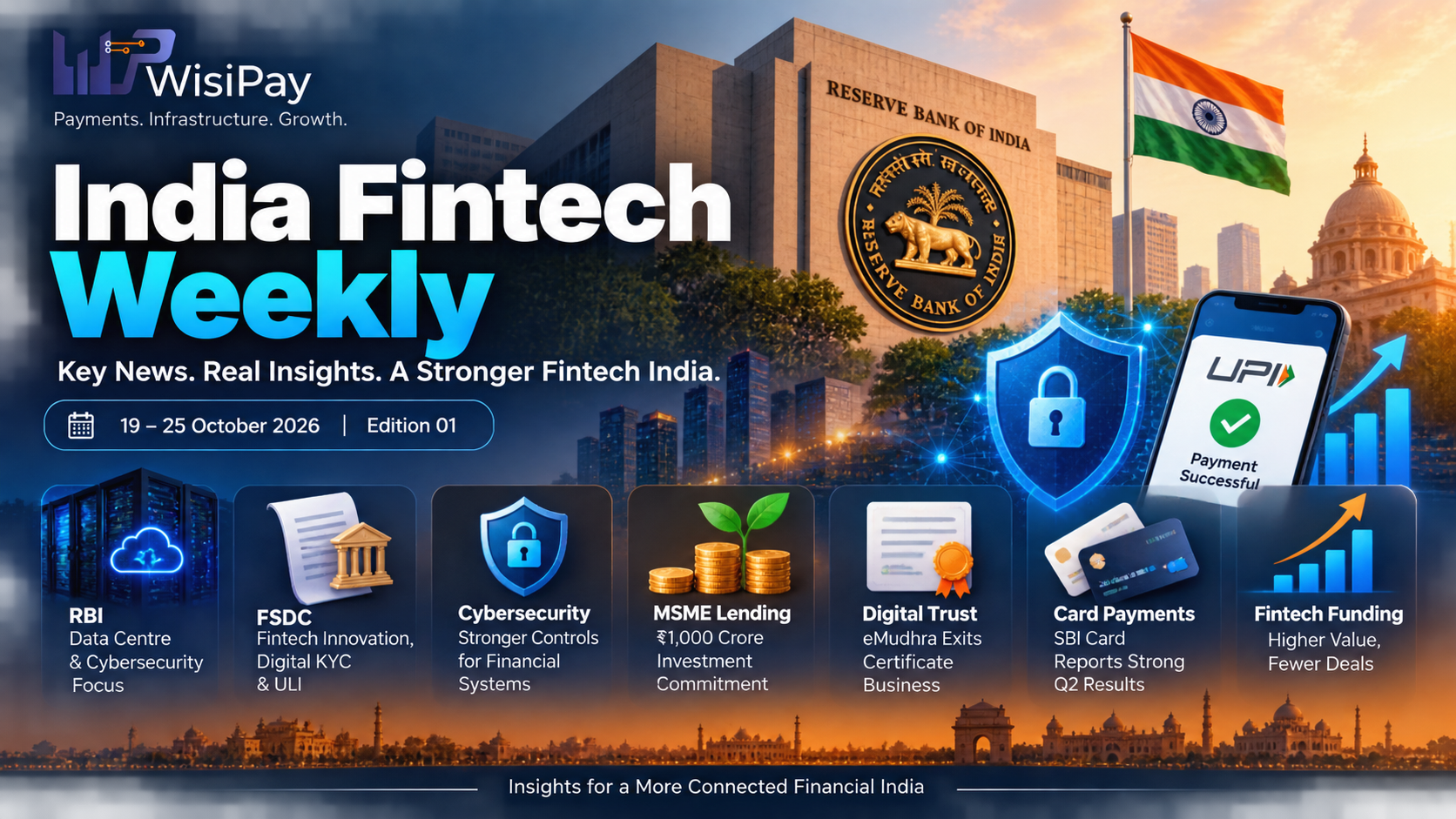
India Fintech Weekly: Cybersecurity, Digital Lending and the Next Phase of India's Payment Infrastructure
India's fintech sector is entering a phase where transaction growth alone is no longer enough. Cyber resilience, digital public infrastructure, lending innovation and operational accountability are increasingly shaping the industry's future.
Executive Summary
The week ending 25 October 2026 delivered an important message for India's financial technology ecosystem: the next stage of digital finance will depend as much on infrastructure resilience and governance as on innovation and scale.
Three major developments defined the week.
First, the inauguration of the Reserve Bank of India's new Data Centre and Cybersecurity Training Institute in Bhubaneswar on 25 October placed secure financial infrastructure at the centre of national attention.
Second, the Financial Stability and Development Council's 23 October meeting highlighted financial-sector cybersecurity, digital KYC, Account Aggregator, Unified Lending Interface and the potential for asset tokenisation.
Third, investment commitments in technology-led MSME lending, alongside developments in digital trust and card payments, demonstrated that fintech opportunities continue to expand beyond consumer payment applications.
Key takeaway: Financial institutions increasingly need systems that are secure, interoperable, auditable and capable of operating reliably at scale.
1. RBI's New Data Centre Signals a Stronger Focus on Financial Infrastructure Resilience
Date: 25 October 2026
On 25 October, Prime Minister Narendra Modi inaugurated the Reserve Bank of India's newly established Data Centre and Cybersecurity Training Institute in Bhubaneswar, Odisha.
According to the official Press Information Bureau release, the facilities are intended to strengthen digital financial infrastructure, cybersecurity capabilities and the reliability of India's banking ecosystem.
The data centre will support critical financial operations, while the associated training institute will help develop cybersecurity and emerging-technology capabilities among financial-sector personnel.
Why This Matters
Financial infrastructure is no longer merely a back-office concern. Payment systems operate continuously, and even short interruptions can affect consumers, merchants, financial institutions and connected technology providers.
The investment reinforces the importance of disaster recovery, system availability, secure hosting, incident response and technology risk management.
Industry implication: Financial institutions and their technology partners should evaluate resilience across the entire transaction lifecycle, including dependencies outside their own applications.
Official source: Press Information Bureau — RBI Data Centre
2. FSDC Puts Fintech Innovation, Digital KYC and Cybersecurity on the Policy Agenda
Date: 23 October 2026
The 30th meeting of the Financial Stability and Development Council, chaired by Finance Minister Nirmala Sitharaman, reviewed important developments affecting India's financial system.
The official release identified fintech innovation, the prospects of asset tokenisation, digitalisation of KYC, wider adoption of Account Aggregator and Unified Lending Interface, and financial-sector cyber resilience.
The Council also reviewed the Financial Sector Cyber Security Strategy developed through inter-agency coordination.
What the Policy Direction Suggests
- Digital KYC: Digital onboarding can reduce friction while preserving appropriate identity and compliance safeguards.
- Account Aggregator: Consent-based financial-data sharing can support underwriting, verification and connected financial services.
- Unified Lending Interface: Standardised access to relevant data can improve credit assessment and support MSME lending.
- Cybersecurity: Resilience requires coordination among regulators, financial institutions and technology providers.
Important clarification: These were policy discussions and reviews, not announcements of a new binding RBI mandate.
Official source: PIB — 30th FSDC Meeting
3. RBI Cybersecurity Advisory Reporting Highlights API and Credential Risks
Advisory date: 19 October 2026
Reporting date: 23 October 2026
According to a 23 October report by The Economic Times, RBI issued an advisory addressing compromised credentials, unauthorised access and security weaknesses across regulated entities and third-party technology environments.
Reported measures included restricting public access to administrative interfaces, enforcing multifactor authentication, reviewing exposed credentials, strengthening API inventories and improving monitoring.
Why This Matters for Payment Technology
Modern payment systems depend on interconnected APIs, credentials, webhooks, financial ledgers and banking integrations.
A weakness in one component can expose a wider financial workflow, particularly where transaction execution depends on trusted server-to-server connections.
Effective controls can include credential vaulting, privileged-access management, transaction limits, beneficiary validation, independent authorisation and tamper-resistant audit logs.
Verification note: The underlying RBI advisory was not independently retrieved as a publicly accessible original document. Specific measures are attributed to the newspaper's reporting.
4. Rs 1,000 Crore Investment Commitment Brings AI-Led MSME Lending Into Focus
Date: 21 October 2026
Premji Invest, Norwest and Lok Capital announced commitments of up to Rs 1,000 crore to support Vegafin, a technology-led MSME lending platform founded by Bijith Bhaskar.
The initiative begins with definitive agreements for the acquisition of a majority stake in Bizloan, a secured MSME-focused NBFC.
According to the original investor announcement, the proposed platform will combine AI-assisted underwriting, digital workflows and data-led credit decisions with physical distribution capabilities.
The Broader Opportunity
MSME lending presents challenges involving incomplete financial records, borrower verification, fragmented data, documentation and credit-risk assessment.
Technology can help financial institutions address these challenges through connected onboarding, data verification, underwriting workflows and portfolio monitoring.
The announced Rs 1,000 crore represents an investment commitment of up to that amount. It does not establish that the entire amount has already been deployed.
Original source: Premji Invest — Vegafin and Bizloan Announcement
5. eMudhra's Certificate-Business Exit Puts Digital Trust Dependencies Under Scrutiny
Date: 22 October 2026
Digital trust company eMudhra announced its decision to voluntarily exit the global SSL/TLS certificate business following a certificate-related security incident.
In its official announcement, the company stated that its infrastructure had not been compromised and that no data breach had occurred.
It also indicated that its digital signature, eSign, enterprise PKI and identity-related businesses would continue operating.
Business Implications
Financial technology platforms rely on digital certificates, cryptographic identities, signing services and trusted communication channels.
Institutions should understand certificate dependencies, renewal procedures, revocation processes and vendor continuity arrangements.
Original source: NSE — eMudhra Official Press Release (PDF)
6. SBI Card's Quarterly Results Show the Scale of India's Card-Payments Business
Date: 23 October 2026
SBI Cards and Payment Services announced its September-quarter results, reporting profit after tax of Rs 778 crore, representing approximately 75% year-on-year growth.
| Metric | Q2 FY27 Result |
|---|---|
| Profit after tax | Rs 778 crore (+75% YoY) |
| Cards in force | 2.32 crore (+8% YoY) |
| Quarterly card spending | Approximately Rs 1.11 lakh crore (+3% YoY) |
These results illustrate the continuing scale of India's card-payment ecosystem.
For payment technology providers, card-processing activity supports demand for transaction monitoring, settlement reporting, reconciliation, issuer integrations and dispute-management capabilities.
An individual issuer's quarterly results should not be treated as a direct measure of the entire Indian card-payments market.
Official disclosure: NSE — SBI Card Quarterly Results (PDF)
7. Fintech Funding Grows in Value While the Number of Deals Declines
Analysis published: 23 October 2026
Data period: January–September 2026
A Business Standard analysis examined the growing concentration of investment capital within India's fintech sector.
Citing Tracxn research, it reported that Indian fintech companies raised approximately USD 2.2 billion during January–September 2026, representing 14% year-on-year growth.
However, the number of funding rounds declined by 41%, from approximately 260 to 153.
| Metric | Reported Figure | Year-on-Year Change |
|---|---|---|
| Funding raised | USD 2.2 billion | +14% |
| Funding rounds | 153 | -41% |
The divergence between funding value and deal count suggests that investors are becoming increasingly selective.
Businesses demonstrating sustainable economics, governance maturity, operational reliability and defensible technology may be better positioned to attract capital.
Data clarification: These are cumulative nine-month figures, not funding activity limited to this week.
8. Aye Finance's Quarterly Earnings Highlight the Economics of MSME Lending
Date: 21 October 2026
Aye Finance reported profit after tax of approximately Rs 86.72 crore for the September 2026 quarter, an increase of around 151% year on year.
Revenue from operations reached approximately Rs 514.39 crore, while the reported gross NPA ratio stood at 4.20%.
The results highlight the importance of balancing credit expansion with risk management and operational efficiency.
For technology providers serving lenders, the opportunity extends beyond onboarding to underwriting workflows, portfolio monitoring, repayment reconciliation, exception management and financial reporting.
Wisi Pay Research: Three Structural Trends Emerging From the Week
The following represents independent industry analysis, not a regulatory statement or investment recommendation.
Trend 1: Payment Infrastructure Is Becoming a Strategic Asset
India's digital payment ecosystem has achieved substantial scale. The challenge now is ensuring that the underlying infrastructure remains dependable as transaction volumes, integration complexity and cybersecurity threats evolve.
RBI's investment in data-centre infrastructure reinforces the importance of availability, redundancy and institutional control.
Reliable payment operations require more than a successful API response. They require visibility into authorisation, execution, confirmation, settlement and reconciliation.
Trend 2: Compliance and Security Are Becoming Product Capabilities
The FSDC's cybersecurity discussions and reported RBI advisory indicate growing attention to financial technology risk.
Security should be incorporated into financial-system architecture through access controls, secure credentials, transaction monitoring, approval workflows and audit evidence.
Trend 3: Financial Technology Is Moving Toward Connected, Modular Infrastructure
Digital KYC, Account Aggregator, Unified Lending Interface, AI-assisted underwriting and payment integrations represent components of an increasingly connected financial ecosystem.
Financial institutions need systems capable of integrating these components without losing operational visibility or control.
What This Means for Banks, NBFCs and Fintech Companies
| Stakeholder | Strategic Priority |
|---|---|
| Banks | Resilience, secure integrations, fraud monitoring and operational oversight |
| NBFCs | Digital underwriting, borrower verification, portfolio risk and lending controls |
| Fintech Companies | Sustainable economics, secure APIs and transparent transaction operations |
| Merchants | Reliable payment processing, dispute resolution and reconciliation |
| Technology Providers | Modular integrations, auditability, security and infrastructure compatibility |
Wisi Pay's Perspective: The Opportunity Beyond Payment Processing
The week's developments support a broader industry thesis: financial institutions increasingly need technology that improves how payment and financial workflows are managed.
For a payment-orchestration technology provider such as Wisi Pay, the relevant opportunity is not to replace banks or regulated payment intermediaries.
It is to help clients integrate and manage financial workflows through technology deployed within their own infrastructure.
That can include intelligent routing, transaction visibility, reconciliation, audit trails, approval controls, monitoring and integrations with financial-service providers.
The value of such infrastructure lies in improving operational transparency and control while allowing clients to retain responsibility for their financial operations and applicable regulatory obligations.
The next competitive advantage in Indian fintech may not be processing more transactions alone, but managing every transaction with greater security, intelligence and accountability.
Outlook: What to Watch in the Coming Week
The next reporting cycle should focus on implementation developments following the FSDC meeting, further publicly available RBI or NPCI announcements, cybersecurity guidance affecting regulated entities and technology-led investments in financial services.
Financial institutions should also watch how lending companies balance portfolio expansion with asset quality, and whether investment continues to concentrate among established fintech businesses.
India's fintech ecosystem remains dynamic, but its long-term strength will increasingly depend on the maturity of the infrastructure supporting it.
Manoj
admin