Payment Gateway Down? Here's Why Your Business Shouldn't Be?

Your Payment Gateway Is Down. Why Should Your Business Be?
"Payment Failed."
Two words. But they quietly cost businesses more than most owners realize — and often, the real culprit is a shaky payment gateway, not the customer.
The customer tries again. Same result. So they pay in cash, or they simply walk away. And here's the thing — you didn't just lose one transaction. You lost a little bit of trust, too.
Most people assume it's the customer's fault. Maybe their card, maybe their bank. But often, it isn't. It's the infrastructure sitting quietly behind the transaction: your payment gateway.
Why a Single Payment Gateway Is a Risk
Every business relies on a payment gateway to move money from the customer's account to theirs. It feels invisible — until it isn't working.
When your payment gateway goes down, even for five minutes, that downtime becomes your business's downtime. One provider having a bad day shouldn't mean your checkout page grinds to a halt. However, for businesses running on a single gateway, that's exactly what happens.
So the real question isn't "did the payment gateway fail." It's "what happens to your business when it does." Explore Wisi Pay's products built to answer that question.
The Real Cost of Gateway Downtime
A failed payment isn't just a missed sale. It adds up in ways that are easy to overlook:
Customers who abandon checkout rarely come back the same day.
Repeated failures chip away at trust, even if your product is great.
Support teams spend hours chasing down "pending" transactions that never resolved.
Finance teams struggle to reconcile payments that live across multiple, disconnected systems.
Because of this, a single point of failure in your payment stack is rarely just a technical issue. It's a business risk hiding in plain sight.
What Payment Orchestration Actually Solves
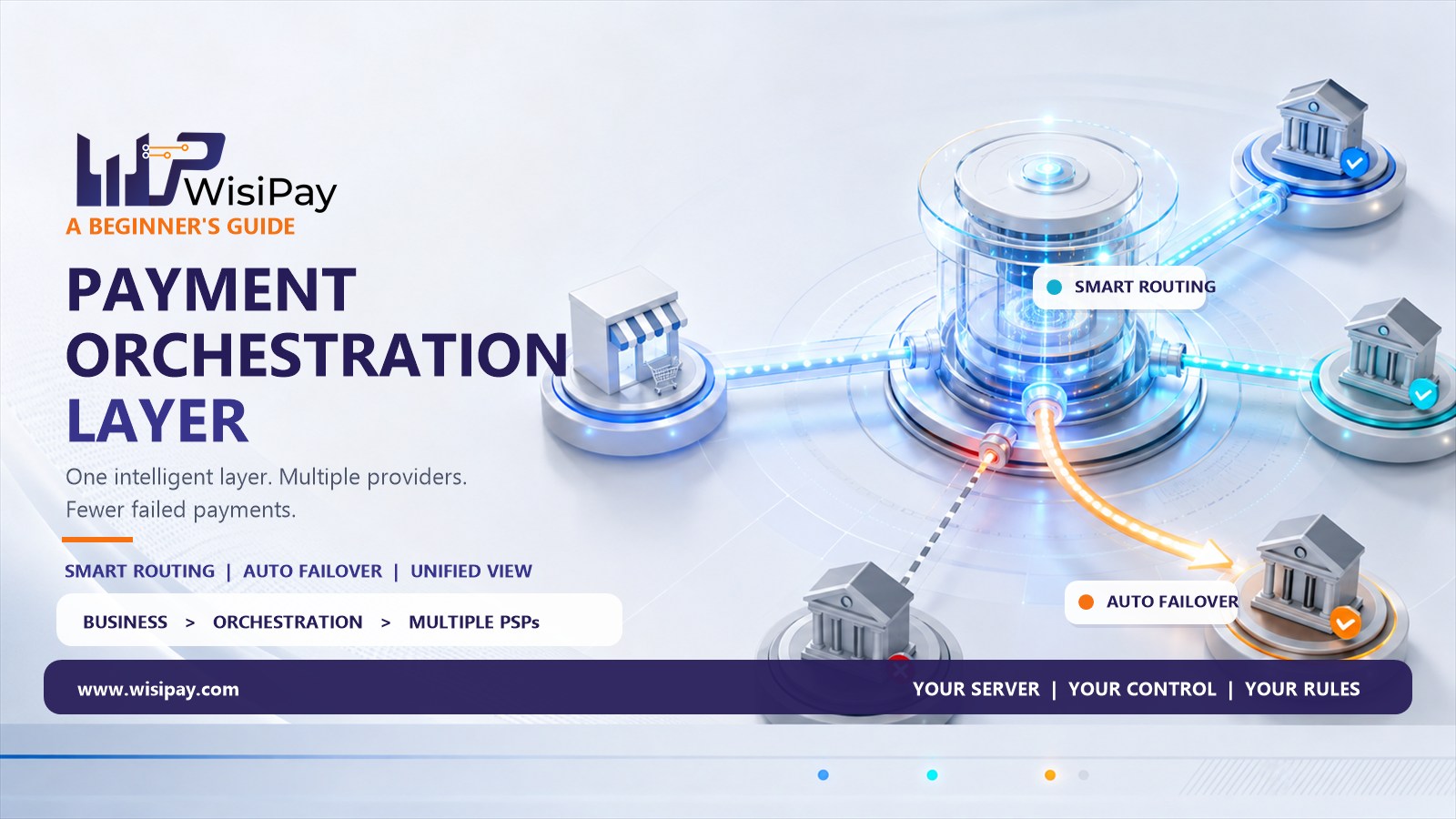
This is the problem payment orchestration is designed to fix. Instead of relying on one payment gateway, orchestration gives you one layer that connects multiple providers — and lets you control every transaction intelligently.
Rather than managing each payment provider separately, an orchestration layer can:
Route transactions across configured providers, based on rules you set
Automatically fall back to another provider when one fails
Track pending transactions through webhooks and status polling
Maintain a clean, accurate accounting trail with a double-entry ledger
Give your operations team visibility the moment something needs human intervention
Consequently, a failing gateway no longer means a failing checkout. The transaction simply finds another path. See how this plays out across different industries we serve.
A Shift in the Question Businesses Ask
Most businesses still ask: "Which payment gateway did we integrate?"
But that's the wrong question once you're managing real transaction volume. The better question is: "What's the best available path for this transaction, right now?"
Because managing five payment providers shouldn't mean managing five separate payment problems. They should work together as one payment infrastructure — not five disconnected tools bolted onto your checkout.
Signs Your Business Needs Payment Orchestration
Not every business needs to worry about this on day one. However, as transaction volume grows, certain signs usually show up first:
Customers occasionally report failed payments that you can't fully explain.
Your support team manually checks with providers to confirm "pending" transactions.
You've had at least one outage where a single provider took your checkout down with it.
Reconciliation across providers takes your finance team hours instead of minutes.
You're considering adding a second or third payment provider, but dread managing them separately.
If even one of these sounds familiar, your payment stack is likely more fragile than it looks. Therefore, it's worth evaluating an orchestration layer before an outage forces the decision for you. Get in touch with our team to talk through your specific setup.
How Payment Orchestration Works, in Practice
Think of orchestration as an air traffic controller for your transactions. Instead of every payment going down one fixed runway, it evaluates the best available route in real time.
For instance, if your primary provider starts failing or slows down, the orchestration layer detects it and automatically reroutes the transaction to a healthy provider. Meanwhile, your customer sees no difference at checkout. They complete their purchase, and your business keeps the sale.
Behind the scenes, though, a lot is happening: webhook events are captured, transaction statuses are polled and updated, and every entry lands correctly in a double-entry ledger. As a result, your operations and finance teams get a single, reliable source of truth instead of five different dashboards that don't agree with each other.
Integrate Once. Orchestrate Intelligently.
That's the direction we're building toward at Wisi Pay. In our view, payments shouldn't be something a business simply hopes will work. They should be infrastructure a business can actually trust — reliable, transparent, and resilient even when one provider has a bad five minutes.
If you're still depending on a single payment gateway, it might be time to ask a harder question: how much business are you losing every month to failed and unresolved transactions? According to industry research from Baymard Institute, payment-related issues remain one of the top reasons for checkout abandonment.
How much business do you think merchants lose because of payment failures and unresolved transactions every month? Share your thoughts below.
SEO TEAM
admin